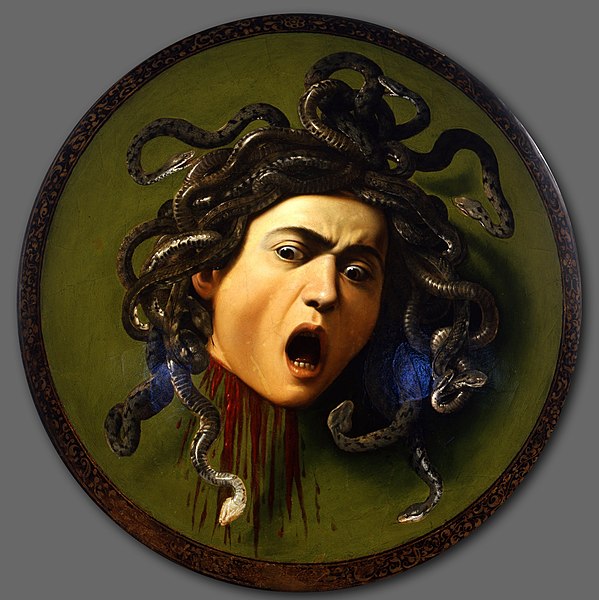
The Gorgons were figures of terror in ancient mythology, three hideous sisters born from the sea god Phorcys and the sea monster Ceto. These formidable beings were said to dwell in desolate corners of the world, far removed from civilization. The two elder sisters, Stheno and Euryale, were immortal, but the youngest, Medusa, was not.
MEDUSA
Stories of Medusa’s origin depict her not as a terrifying snake headed beast, but as an incredibly attractive young maiden. Having flourished into her womanly beauty, Medusa had caught the eye of the mighty sea god Poseidon, who made numerous futile attempts to seduce her despite her rejection of his advances. Poseidon was not one to be refused, and one day he raped Medusa in a temple of Athena.
Outraged and disgusted by the act that had stained her sacred space, Athena unleashed her wrath on the poor girl, transforming Medusa’s once beautiful features into an appearance so monstrous, so hideous that no man would ever look upon her again.
THE MYTH OF PERSEUS
King Polydectes had fallen in love with Danaë, the mother of Perseus. Perseus, however, did not trust Polydectes, and kept Danaë as far from him as possible. Wishing to remove Perseus from the picture, Polydectes devised a cruel plan. He instructed Perseus to bring him the head of the Gorgon Medusa, assuming that the young man would not make it back alive.
Athena assisted Perseus on his journey, providing him with a shield and a mirror, allowing him to confront the Gorgon without having to meet her deadly gaze. With these items, Perseus successfully decapitated Medusa, letting the head roll away and the body spasm convulsively before falling to the ground. From the severed neck, the children she had conceived with Poseidon were born; the winged horse Pegasus and the giant Chrysaor.
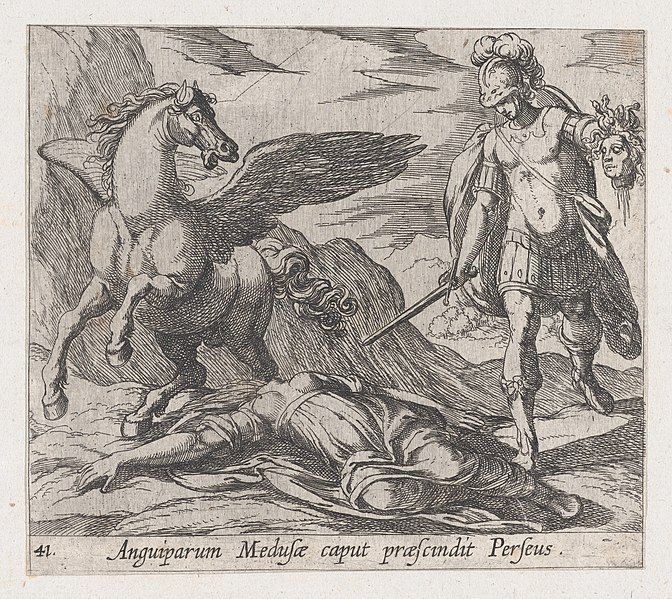
Though Medusa was dead, her head had retained its poisonous glare, so to safely transport it Perseus wrapped it in a cloth and began his journey home.
To his horror, however, Perseus returned to discover that his mother, abused by Polydectes, had fled to seek refuge in a temple. Enraged at Polydectes’ behaviour, Perseus strode into the throne room where Polydectes and his companions were gathered. Without hesitation, he withdrew Medusa’s sticky head from the cloth and pointed it at the men, instantly turning them to stone.
APPEARANCE AND ATTRIBUTES
The Gorgons were traditionally described as repulsive and monstrous in appearance, though some later portrayals presented them in a more alluring light. Contrary to the image of long and healthy hair, their heads were covered with spitting, squirming snakes that lashed out at those who came near.
The blood of a Gorgon was believed to have dual qualities; it could both heal and inflict great harm. This arose from Apollodorus’ idea that blood in the right side of the Gorgon’s body had beneficial, restorative powers, while blood in the left side was venomous to mankind.
The name Gorgon is associated with guttural noises of the throat such as growls, screeches or roars. The Gorgons were indeed known to release cries chilling enough to freeze the blood, for they were sounds that emanated the deep-seated hatred and rage they felt towards the curse imposed upon them, and embodied the anguish of their transformed existence.
 Ethereal Chronicles

,_from_Ovid%27s_%27Metamorphoses%27_MET_DP864703.jpg)
Leave a comment