“We made good progress and had just come within call of the shore when the Sirens became aware that a ship was bearing down upon them, and broke into their high, clear song.
‘Draw near, illustrious Osysseus, man of many tales, great glory of the Achaeans, and bring your ship to rest so that you may hear our voices. No seaman ever sailed this black ship past this spot without listening to the honey-sweet tones that flow from our lips and no one who has listened has not been delighted and gone on his way a wiser man…’
…This was the sweet song the Sirens sang, and my heart was filled with such a longing to listen that I ordered my men to set me free, gesturing with my eyebrows. But they swung forwards and rowed ahead, while Perimedes and Eurylochus jumped up, tightened my ripes and added more.”
– Homer’s Odyssey, Book 12 (185-197), Penguin Classics
THE EARLY SIREN
The very first tales of Sirens originated from the mysteries of Greek Mythology. Unlike the mermaid-like figures we are familiar with today, the Greek Sirens were depicted as human headed birds.
APPEARANCE AND ATTRIBUTES
Sirens, half bird, half human, were monstrous creatures, capable of luring men to their deaths with the allure of their haunting songs. There were fifteen original Sirens, who lived on the island of Anthemoessa, destroying any ship that passed by.
Sirens typically induced delusion with the power of their voices, causing shipwrecks after which they would consume the unfortunate victims’ flesh. Homer gruesomely described them as living amongst a meadow surrounded by rotting human corpses.
Author Hyginus claimed that Sirens’ lives were short, and that once a passer by had listened to her song the Siren who sang it was doomed to die.
The first of the Sirens were not creatures of lust but of wisdom, as in the Odyssey their call to Odysseus was an invitation to eternal knowledge; the Sirens knew everything on earth, including the events of the Battle of Troy and the deep suffering it had caused.
SIRENS IN THE ODYSSEY
After living with the witch Circe, Odysseus made his way home with her instructions in mind. Upon reaching the land of the Sirens, Odysseus ordered his men to plug their ears with wax so that the poisonous notes would not find their ears.
However, desiring to hear the song for himself, he instructed them to tie him firmly to the mast with his ears unblocked. Though Odysseus struggled against the bonds as he began to hear the song, his men remained steadfast, continuing onwards.
SIRENS IN THE ARGONAUTICA
Jason also encountered the Sirens on his voyage. Despite the crew almost falling victim to the creatures, Orpheus brought out his lyre, playing music so beautiful even the song of the Sirens could not overcome it, and the men passed through safely.
LATER DEPICTIONS OF THE SIREN
Although the image of Sirens as birds disappeared over time, some art retained elements of their original form, depicting them with bird wings as well as fish tails.
The modern Siren is far more ferocious than her ancestors. A Siren lurks in the depths of the sea, often emerging during storms and violent weather to tear sailors from their ships, dragging them to the sea floor to drown and devour them. She has the tail of a fish, with harsh fins, and scales covering the human half of her body. Her skin is pale, almost translucent, with gills on either side of her neck to help her survive underwater.

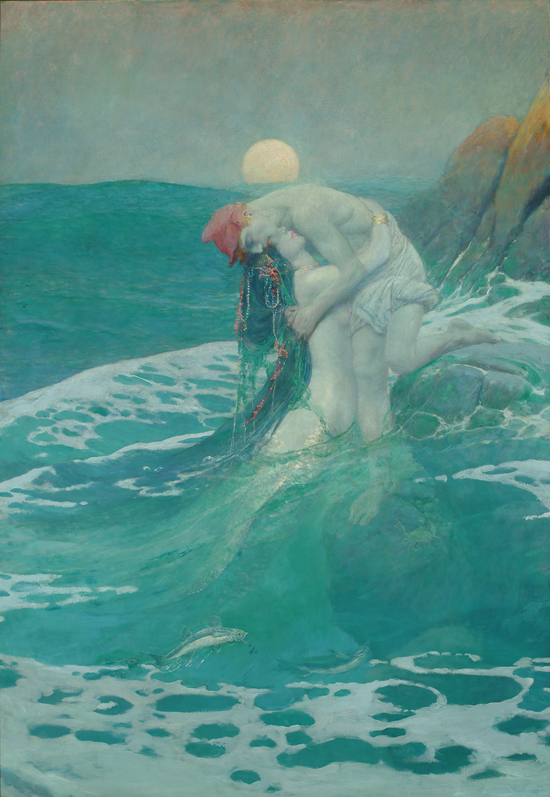
Her song, when sung to a human, makes her appear incredibly appealing, stirring in men an irresistible urge to take a swim with her, or lean in for a kiss. Once a man falls victim to his lust, her appearance shifts into her true, terrifying form.
MERMAIDS
Mermaids are somewhat kinder than their aquatic sisters, with softer, more beautiful features. They may choose to interact with humans or remain utterly disinterested. Like Sirens, they also dwell in the sea, but can also navigate through freshwater such as rivers or lakes.

You might see a mermaid with a comb and a mirror, symbols of her beauty and her sexuality, as mermaids are often depicted as vain creatures.
The appearance of a mermaid may signal impending rough weather, and in British folklore, these creatures are frequently considered omens of death and disaster. They may steal, blind or drown humans, often singing enchanting songs as they do so.
However, mermaids may also be benevolent, bringing good luck to those who aid them if they find themselves trapped or injured. A mermaid might offer three wishes to a human in return for something valuable, but such a promise should be approached with caution. Like the Fae, mermaids are mischievous, and may trick you into giving up something you didn’t intend to.
In rare cases, a mermaid may fall in love with a human. However, the call of the sea is irresistible, and regardless of how deep her love is a mermaid can only stay away from the water for so long.

MERROWS
The Irish variation of mermaids is the Merrow, which can be either male or female. Merrows are notably friendlier than Mermaids or Sirens, often engaging in civil communication with humans. They typically have green hair or skin, and are always seen wearing a red cap, without which they are unable to return to the sea.
You might also like
 Ethereal Chronicles

Leave a comment