KING MINOS AND PASIPHAE
On the island of Crete, Minos and his wife Pasiphae were promised a fruitful life when Minos ascended to the throne as King. Once his affairs had been sorted, Minos offered his gratitude to Poseidon, mighty ruler of the seas, requesting from the god a white bull as a sign of good fortune and divine favour.
Poseidon agreed, and Minos received a magnificent bull with a pale, dusty white coat. Enamoured by the beauty of the creature, Minos could not bring himself to sacrifice it to Poseidon, thinking it a shame despite fearing the possible consequences.
POSEIDON’S CURSE
Enraged by Minos’ disobedience, Poseidon decided to punish Minos with Cupid’s arrow, causing Pasiphae to fall madly in love with the bull Minos so cherished.
Poseidon’s curse was impossible to resist, and Pasiphae, desperately attracted, sought out the help of the craftsman Daedalus, who had recently been welcomed into their kingdom along with his handsome son Icarus. Pasiphae begged Daedalus, who was not one to refuse a queen, to assist her in seducing the beast. Eager for a hefty reward, Daedalus crafted a large hollow cow into which Pasiphae climbed and used to trick the bull into mating with her.
HALF MAN, HALF BEAST
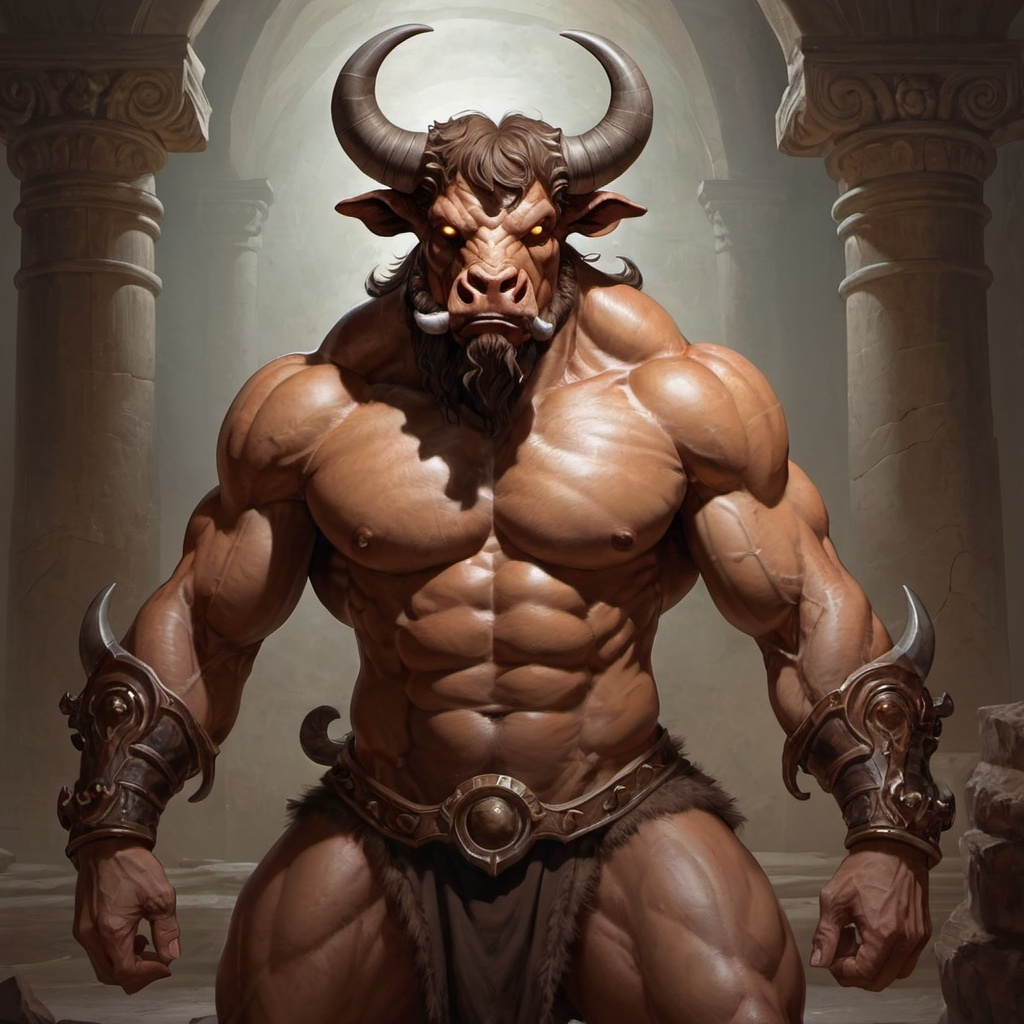
From this monstrous, immoral union, a child was born. His body was small and fragile, his smooth hands balled into tiny fists, but a hideous bellowing came in place of his cry, and his face bore the curse. He lacked the gummy smile, the rosy cheeks of a newborn. Instead, his skin was leathery, covered with hair and horns as he grunted and growled in his mother’s grasp.
Pasiphae, consumed with maternal love for her child, tried desperately to nurture him into shape, hoping he would behave as a normal boy should. But the Minotaur, more beast than man, grew steadily more violent, more enraged, until even Pasiphae was unable to control him, and Minos knew that it was time to take action.
THE LABYRINTH
Minos instructed Daedalus to fix the mess he had helped create, ordering him to construct a complex labyrinth to contain the beast. Daedalus complied, building the labyrinth near Knossos. But Minos, his rage having festered over the years, was not yet done punishing the craftsman, and threw Daedalus and Icarus into a tower, imprisoning them there for life.
Thus the Minotaur, cast away and forgotten, lurked in the dim depths of his own prison, while Minos turned to other pressing matters.

WAR WITH ATHENS
An ongoing conflict with Athens had resulted in the death of his beloved son, Androgeus, fuelling Minos’ hatred for the Athenians. Determined to avenge his loss, Minos wagered a war that he quickly won. Following Athens’ defeat, Minos decreed that each year, seven male and seven female Athenians would be offered up as sacrifices for the Minotaur.
THESEUS
Time passed before the prince of Athens, Theseus, expressed to King Aegeus his resolve to kill the Minotaur. He had no desire to inherit a city owing a payment so bloody, nor did he wish to see his people in fear. Theseus left for Crete on a ship with a black sail, promising his father that upon success, the ship would return in white. Aegeus bade him farewell, praying fervently for his son’s safe return.
When Theseus came to Crete, along with the eleven other men and women offered up for the Minotaur, he caught eyes with Minos’ daughter, Ariadne, who fell in love with him. The night before Theseus was to enter the labyrinth, she came to him with a ball of thread, explaining that the only safe path was forward or downward, and never left or right. The thread, she assured him, would guide him back out of the maze should he manage to slay the monster. Grateful for her kindness and dazzled by her beauty, Theseus thanked the princess, promising her that they would return to Athens together.
THE DEATH OF THE MINOTAUR
The manner in which Theseus killed the Minotaur remains uncertain; some accounts suggest that he may have used his bare hands after his weapons were confiscated at the labyrinth’s entrance. Others suggest that he concealed a blade in his tunic, using it to fatally wound the beast.
After killing the Minotaur, Theseus led the remaining Athenians out of the labyrinth by following the thread he had unravelled behind him.
THESEUS’ BETRAYAL
Theseus swiftly departed Crete, taking Ariadne and the survivors with him. On their way home, they rested on the island of Naxos. Here, Theseus cruelly abandoned Ariande before continuing on to Athens.
Ariadne, though initially heartbroken, was later found by Dionysus, the god of wine, who took her as his wife.
THE DEATH OF AEGEUS
Theseus returned triumphantly, filled with pride for accomplishing the seemingly impossible task. But his euphoria had made him forgetful, and the sails of his ship were still black as he came closer to shore.
Aegeus, who had been anxiously waiting for the arrival of his son, saw the black sails and let out a cry, believing that Theseus had perished at the hands of the Minotaur. Overwhelmed with grief, Aegeus threw himself out into the water before him, drowning in what is now known as the Aegean sea.
Perhaps it was Theseus’ ignorance, his betrayal, that led to such a bittersweet end, but the death of his father brought with it a new beginning, and he was crowned the new King of Athens.
 Ethereal Chronicles
Leave a comment