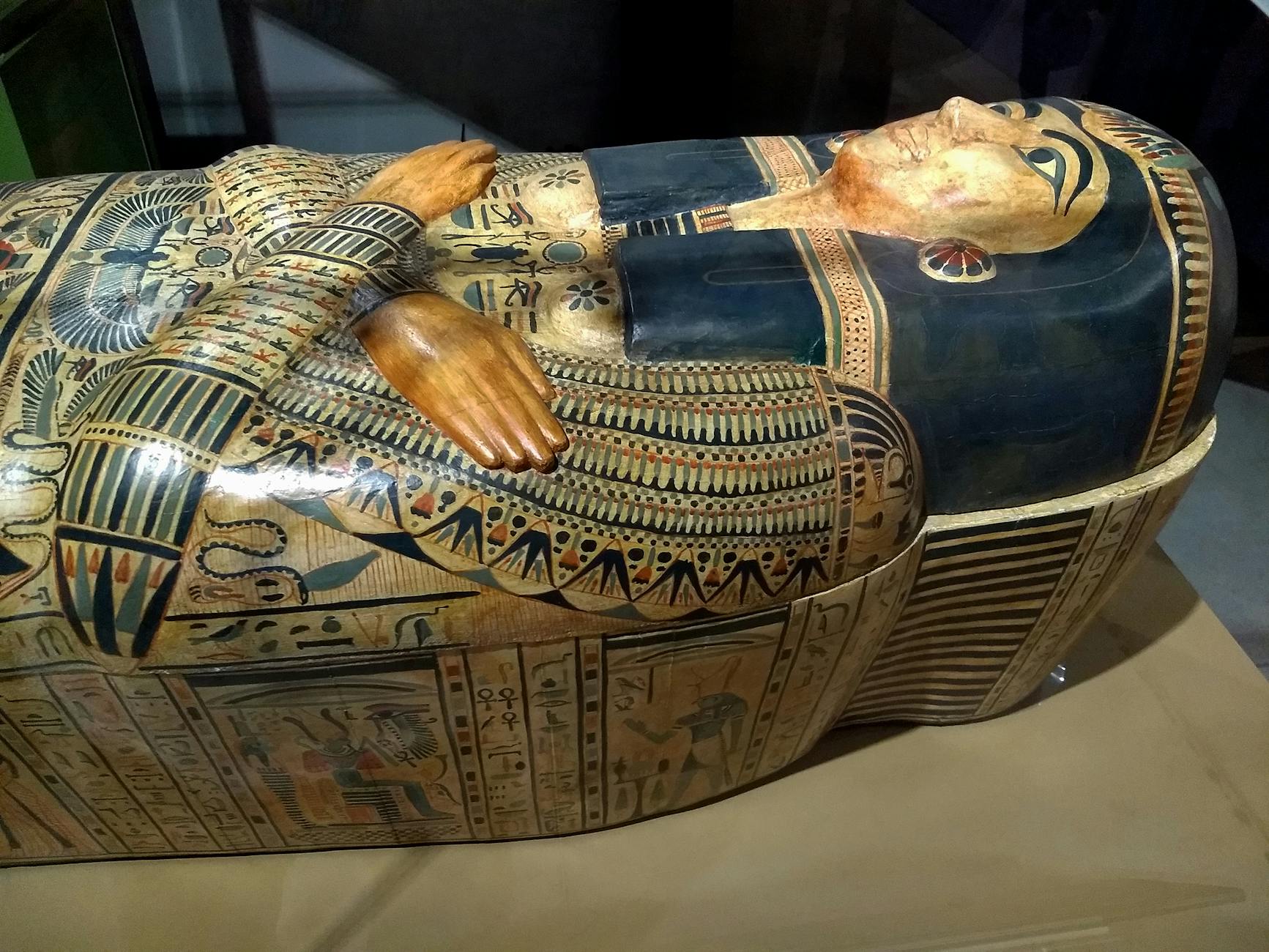
In Ancient Egyptian culture, death was the most crucial part of life, a pivotal moment in one’s existence that individuals spent their entire lives preparing for.
The Book of the Dead
The Book of the Dead was a complex book filled with instructions and protective incantations that helped achieve a smooth journey into the afterlife. It was essentially a guide, designed to assist in navigating the challenges that lay in the underworld, helping souls towards the ultimate destination of eternal peace.
Mummification
The process of mummification took around 70 days, and included 4 important steps:
- REMOVAL OF INTERNAL ORGANS. Internal organs were extracted from the body, usually through the nose.
- DRYING OUT THE BODY FOR PRESERVATION. The body was placed in salt for 40 days to dry it out.
- DRESSING UP THE BODY. Elaborate jewellery, personal items and protective symbols such as the scarab were placed on the body, intended to accompany the soul into the afterlife.
- WRAPPING THE BODY. The body was carefully wrapped in linen, to both preserve the body and safeguard the soul in case it decided to return.
Tombs
Tombs did not only serve as resting places for the dead. They were spaces filled with treasures, personal belongings, funerary prayers/spells and items that might help on your journey to the afterlife. Statues were created to present an idealised version of the deceased, ensuring that they left the earth in their most pristine forms.
The Duat
To reach the afterlife, everybody, even the purest of heart, had to travel through the Duat, an underworld fraught with demons and lakes of fire, stretching like an endless desert. In order to pass through and reach the next stage, the deceased were required to overcome 12 gates, which were each guarded by some sort of threatening deity. To make this easier, many people were buried with information and passwords which they could use to pass the tests with ease. Only once this was done would they finally be judged by Maat, Anubis and Osiris on whether they were worthy of being admitted into the afterlife.
Judgement
Once the souls had passed through all twelve gates, they would reach the Hall of Maat, where they would be judged. Maat was the personification of justice, morality and truth. The individual’s heart would be weighed against a feather of Maat on a set of scales. If they had led a pure, honourable life, then their heart would be lighter than the feather, and they would be granted passage to a serene afterlife. However, if the person had led a dishonest, sinful life, then their heart would be heavier than the feather, and faced a grim fate. The heart was carelessly tossed to Ammit; a monster that was part lion, part hippopotamus and part crocodile. Ammit would devour the heart and with it the soul of the individual, who would die and be wiped from existence.
 Ethereal Chronicles
Leave a comment